LAKE DICKHEAD
APPARENTLY, WE’RE RENAMING LAKES NOW…BECAUSE ANYONE CAN.
On August 25, 2026, the President of the United States suggested that Lake Ontario—a rather large body of water shared by Canada and the United States—should instead be called “Lake America.” Two days later, with a stroke of the presidential pen, he signed an executive order directing the U.S. government to call it exactly that. Canada, notably, does not have to.
That got us thinking...
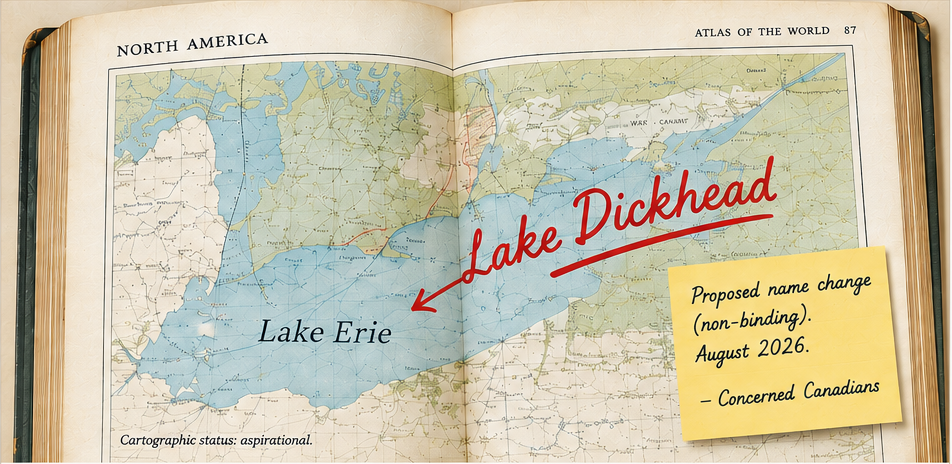
A modest, citizen-led Canadian counterproposal:Rename Lake Erie to Lake Dickhead.
Naturally, it carries precisely as much unilateral authority as you’d expect.
OUI, IL Y A UNE VERSION FRANÇAISE.
Proudly available in Canada's two official languages.
Because that's how we roll.
Quebec has been protecting the French language for generations. We had an afternoon and a keyboard. We’ll do better when our translation budget exceeds CAD $0.00. Please forgive any translation errors, lost nuances, awkward phrasing, misplaced accents or other unintended offences against the French language.
Why Lake Dickhead?
We didn’t arrive at this name lightly.
Well, actually, we did.
It’s memorable.
Whatever else one might say about Lake Dickhead, nobody is going to forget which lake you’re talking about.
It’s easy to pronounce.
In English, anyway.French-language pronunciation guidance is available, tariff-free.
It captures the moment.
Relations around the Great Lakes have become a little...
Erie.
Sorry. We had to.
It requires remarkably little infrastructure.
No canal construction.
No shoreline modifications.
No relocation of Cleveland.
Just a map, a keyboard, a social media account and the confidence to proceed without waiting for anyone else to agree.
And most importantly...
We prefer to think of it as a modest contribution to a distinguished satirical tradition: Voltaire. Mark Twain. Stephen Leacock. Roch Carrier...and Alfred E. Neuman.
Lake Erie is still Lake Erie.
Which, when you think about it, is rather the point—no matter what anyone chooses to call it.
So what say you?
VOTE NOWACTUALLY, ABOUT THE NAME “ERIE”...
Before we run the Erie/eerie joke completely into the ground, an important footnote.
Lake Erie isn't called Erie because generations of people found it vaguely unsettling.
The name comes from the Erie people, an Indigenous nation that lived along the lake's southern shore when Europeans arrived in the region.
So while we're having some fun with geography, the real name has a real history.
And that underscores something worth remembering:
Place names aren't just words on maps.
They carry history, culture, identity and memory.
Changing one is sometimes appropriate.
But it's generally worth having a better reason than waking up one morning and deciding you'd prefer something else.
Learn more about the history of the name Lake Erie →THE MANDATE, SUCH AS IT IS
WAIT. CAN SOMEONE ACTUALLY JUST RENAME A LAKE?
Short answer:
Not for everybody, no.
Slightly longer answer:
On August 27, the U.S. government did exactly that for its own federal usage: an executive order directed the Department of the Interior to implement the name “Lake America” for Lake Ontario.
That does not rename the lake for Canada—or require anyone else to use the same name.
Governments have official processes for geographical names, and different governments can determine what their own agencies and maps call a feature.
Lake Ontario and Lake Erie are international waters shared by Canada and the United States.
In Canada, Lake Ontario / Lac Ontario and Lake Erie / Lac Érié remain official geographical names.
There are actual naming authorities.
There are processes.
There are records.
There is paperwork. Quite a lot of it, presumably.
We realize this may come as disappointing news to the internet.
Explore Canada’s official geographical names →So can LakeDickhead.ca rename Lake Erie?
Absolutely not.
We checked.
A NOTE TO OUR AMERICAN FRIENDS
This isn't about you.
Really.
Canadians and Americans share families, businesses, communities, musicians, comedians, sports leagues, a language in which we occasionally disagree about spelling and the final letter of the alphabet, an enormous border and five exceptionally large lakes.
We have fought beside one another.
Built things together.
Traded an almost ridiculous quantity of stuff back and forth.
And spent generations good-naturedly arguing about who invented what.
This website isn't a complaint about Americans.
Quite a few of you probably think Lake Dickhead is funny too.
You're welcome to vote.
In fact, seeing American votes in the results makes the whole thing considerably better.
We're neighbours. Or neighbors.
And neighbours occasionally disagree.
Good neighbours can also recognize when something has become a little ridiculous.
Sometimes they can even laugh about it together.
Americans may vote too.
NOW, SOMETHING THAT MIGHT ACTUALLY ACCOMPLISH SOMETHING
We've had our fun.
Mostly.
But if recent events have made you think a little more carefully about Canada, our economy and where the things you buy actually come from, there is something more useful you can do than rename a lake.
Spend thoughtfully.
Buying Canadian isn't about being angry at somebody else.
It can simply mean choosing, when it makes sense, to support Canadian workers, farmers, manufacturers, entrepreneurs and communities.
No grand gestures required.
Just information.
And perhaps a little more attention to the label.
WHERE TO FIND CANADIAN PRODUCTS
Here are some resources to help you understand labels and find Canadian products:
Government of Canada - Made in Canada
Official information about Canadian products, labels and how to recognize them.
VISIT RESOURCECanadian Food Inspection Agency
A plain-language guide to identifying Canadian food and understanding common label claims.
READ THE GUIDECompetition Bureau Canada
The detailed rules and guidance behind “Made in Canada” and “Product of Canada” claims for manufactured goods.
SEE THE RULESMade in CA
A large independent directory of Canadian-made products, businesses and grocery items.
BROWSE MADE IN CAMadeinCanada.dev: Discover more products made in Canada
Products — clothing, food, home, beauty and more — from verified Canadian brands.
SEARCH FOR CANADIAN PRODUCTSCIRA - Buy Canadian
Guides and resources from the organization behind Canada's .ca domain.
EXPLORE THE GUIDEABOUT THIS COMPLETELY UNAUTHORIZED PROJECT
LakeDickhead.ca is an independent Canadian satirical project.
It began with a fairly simple observation: if one country can unilaterally decide what to call a lake it shares with another country, Canadians are perfectly capable of making an equally authoritative suggestion of our own.
So we did.
The site is satire. The proposal is unofficial. The vote is non-binding. Lake Erie remains Lake Erie.
Behind the joke is a slightly more serious point about neighbours, sovereignty, history, the names we give places and the occasional usefulness of responding to absurdity with more absurdity.
The person behind the project is a private Canadian citizen who prefers to remain out of the story.
Which seems reasonable.
They'd be too polite to insert themselves into an international naming dispute without being invited.
THE FINAL WORD
Lake Erie is still Lake Erie.
In Canada, Lake Ontario is still Lake Ontario.
Canada is still Canada.
The United States is still the United States.
And, contrary to recent evidence, geography remains a collaborative discipline.
Take care of the lakes.
Be good to the neighbours.
And when in doubt:
Use your words.